
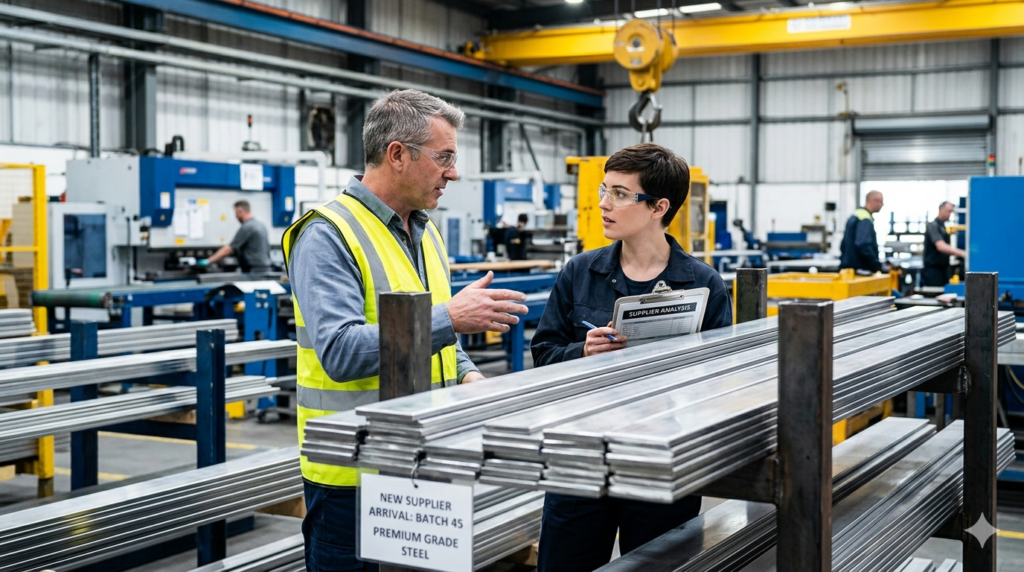
Summary
A mid-sized engineering factory running consistent production lines noticed something troubling – not in their machines, not in their workforce, but in the raw material arriving at their loading dock every month. Their aluminium flat bars were showing dimensional inconsistencies, surface defects, and alloy mismatches that cost them weeks of rework, client escalations, and hard money. After a structured internal audit, they made one decision that changed everything: they switched their aluminium flat bars supplier. This article unpacks that real-world decision, what drove it, what they looked for in a new supplier, and why HHhub has become the trusted name for factories that can no longer afford to gamble on material quality.
The Day the Production Manager Asked the Uncomfortable Question
It started with a rejection notice.
A batch of fabricated structural frames – meant for a large commercial construction client – came back with a single annotation: Dimensional non-conformance. Flat bar width deviation beyond tolerance.
The production manager walked the floor that afternoon and asked his team one question: Is this a machining problem or a material problem?
The answer took three days of internal testing to confirm. The aluminium flat bars delivered by their existing supplier were not holding to the specified 6061-T6 grade tolerances. Width variance across a 100-piece batch ranged from 0.4mm to 1.1mm beyond the accepted threshold. In precision-dependent fabrication, that is not a small number.
And that was only the beginning.
What Was Going Wrong – The Real Problems Behind the Switch
Before any factory changes its aluminium flat bars supplier, something has to break badly enough to justify the disruption. In this case, it was not one problem – it was a slow accumulation of five.
1. Dimensional Inconsistency Across Batches
No two deliveries from their existing supplier matched exactly. The factory’s QC team had begun keeping a manual log of batch variances. Over six months, they recorded tolerance deviations in 38% of incoming flat bar consignments. The issue was not catastrophic in any single delivery – it was the grinding unpredictability of it.
When you are running tight fabrication lines with CNC machinery pre-set to material specifications, a 0.8mm width variance means reset time, rejected cuts, and delayed dispatch.
2. Alloy Grade Substitution Without Disclosure
This one was harder to spot – and far more damaging when it surfaced.
The factory had been ordering 6061-T6 aluminium flat bars. Testing on retained samples revealed that some consignments had been fulfilled with 6063-T5 material – a grade with meaningfully lower yield strength. The two grades look identical to the naked eye. Without chemical composition testing, substitution goes undetected.
For structural applications where 6061-T6’s yield strength of approximately 276 MPa is engineered into the load calculations, receiving 6063-T5 – which carries roughly 145 -186 MPa yield strength – is not a minor variation. It is a liability.
3. Surface Defects and Finish Failures
Anodizing and powder coating are downstream processes that depend entirely on the quality of the aluminium surface arriving at that stage. The factory’s finishing contractors began flagging irregular pitting, mill scale residue, and edge burring on flat bars that made consistent anodizing results impossible.
A compromised surface finish does not just look poor – it shortens the service life of the finished product and, in architectural or marine applications, can lead to premature corrosion.
4. Lead Time Failures During Peak Demand
Twice in a single quarter, the supplier failed to deliver within the committed lead time window. Both instances pushed the factory into emergency procurement from spot-market sources – at significantly higher cost and with no certainty of grade compliance.
Supply chain reliability is not a luxury. For a factory running on-time-delivery KPIs with downstream clients, a supplier who cannot hold a lead time commitment is a structural business risk.
5. No Mill Test Reports. No Traceability.
When the factory’s QA team formally requested mill test reports (MTRs) for the last three delivered consignments, the supplier provided documents that were incomplete, lacked heat number traceability, and in one case appeared to reference specifications not applicable to the ordered grade.
Traceability is not paperwork. In sectors like aerospace components, structural construction, and automotive manufacturing, material traceability is a contractual and regulatory requirement. Without it, entire project certifications can be invalidated.
The Supplier Evaluation Process – What the Factory Looked For Next
After the internal audit was complete, the procurement team built a structured supplier evaluation framework before approaching any new aluminium flat bars supplier. Here is what they prioritized.
Supplier Evaluation Criteria Used by the Factory
| Evaluation Parameter | Minimum Requirement | Why It Mattered |
| Grade Compliance Verification | Chemical composition test reports per batch | Prevent alloy substitution |
| Dimensional Tolerance Control | Within ±0.1mm on width and thickness | CNC machining compatibility |
| Mill Test Report Availability | Full MTR with heat number traceability | Regulatory and client compliance |
| Surface Finish Standard | Mill finish or anodized, burr-free edges | Downstream finishing quality |
| Lead Time Reliability | Stated lead time with a written SLA | Production planning certainty |
| Certifications Held | ISO 9001, ASTM B221, or equivalent | Quality system assurance |
| Custom Cutting Capability | Cut-to-length with precision tolerance | Waste reduction and cost control |
| Minimum Order Flexibility | Suitable for both small and bulk orders | Cash flow and inventory management |
Understanding Aluminium Flat Bar Grades – Why Getting It Right Is Not Optional
One of the most consequential decisions in aluminium procurement is grade selection. Not because it is complex – but because the differences between grades have direct consequences on performance, and many buyers do not have the technical knowledge to catch substitution when it happens.
Here is a clear breakdown of the most commonly specified grades in industrial flat bar procurement.
Aluminium Flat Bar Grade Comparison for Industrial Use (2026)
| Grade | Key Alloying Elements | Yield Strength (MPa) | Primary Applications | Finish Quality | Weldability |
| 6061-T6 | Silicon, Magnesium | ~276 MPa | Structural fabrication, marine, transport | Good | Excellent |
| 6063-T5 | Silicon, Magnesium | ~145–186 MPa | Architectural, decorative, anodized work | Superior | Very Good |
| 6063-T6 | Silicon, Magnesium | ~186 MPa | High-finish architectural, electrical panels | Superior | Very Good |
| 5052-H32 | Magnesium, Chromium | ~193 MPa | Marine, coastal, chemical environments | Good | Good |
| 2011-T3 | Copper | ~296 MPa | Precision machined components, screws | Moderate | Poor |
| 7075-T6 | Zinc, Magnesium, Copper | ~503 MPa | Aerospace, high-load structural parts | Moderate | Limited |
The factory had been receiving applications that required 6061-T6 but getting material closer to 6063-T5 in mechanical behaviour. On paper, both are aluminium. In practice, the difference in structural capacity is significant enough to matter in safety-critical applications.
A reliable aluminium flat bars supplier does not just deliver the material — they deliver the certified, traceable, grade-verified material you specified. That distinction is the entire value proposition.
Why HHhub Became the Factory’s New Aluminium Flat Bars Supplier
After evaluating multiple suppliers against the criteria above, the factory selected HHhub as their primary aluminium flat bars supplier. The decision was not made on cost alone; in fact, HHhub was not the cheapest option on their shortlist.
It was made on something harder to replace than low pricing: consistent, verifiable, accountable supply.
Here is what made the difference.
Grade Integrity With Full Traceability
HHhub provides mill test reports with every consignment. Each report carries heat number references that allow the factory to trace material back to the originating production batch. This is not a courtesy – for the factory’s aerospace and construction clients, it is a contractual prerequisite.
Every flat bar delivered by HHhub is verified against the specified alloy grade before dispatch. Substitution, whether intentional or through supply chain error, does not reach the customer’s loading dock.
Dimensional Precision That Holds Across Batches
The factory’s CNC teams reported an immediate improvement in setup consistency after switching. Flat bars arrived within specified dimensional tolerances — consistently. Not just in the first delivery, but in every subsequent one.
Precision is not an occasional achievement. It is a process discipline. HHhub’s manufacturing controls and quality inspection protocols treat dimensional conformance as non-negotiable, not aspirational.
Surface Finish Ready for Downstream Processing
Whether the factory’s downstream process is anodizing, powder coating, welding, or precision machining, HHhub’s flat bars arrive with clean mill finishes, right-angled or R-rounded edges as specified, and without the burring or pitting that had plagued their previous supplier’s material.
A consistent surface is not aesthetic. It is functional. It determines how a coating bonds, how a weld holds, and how long the finished product lasts in service.
Custom Cut-to-Length With Fast Lead Times
HHhub offers precision cut-to-length capability across standard and custom flat bar dimensions. This allows the factory to order material ready for their production line – not oversized stock that generates offcut waste and storage cost.
Lead time commitments from HHhub are held. The factory has not made a single emergency spot-market purchase since switching.
Certifications That Open Doors
HHhub operates with ISO-compliant quality management systems and supplies flat bars that meet ASTM B221 and equivalent international standards. For the factory’s clients in regulated sectors, having a certified, documented supply chain is not a differentiator – it is a table-stakes requirement.
The Industries That Cannot Afford the Wrong Supplier
Aluminium flat bars are not a single-sector product. They move through some of the most demanding industrial environments in the world. In each of those environments, material failure carries consequences far beyond a rejected batch.
Industry Applications of Aluminium Flat Bars and Consequences of Grade Non-Conformance
| Industry Sector | Common Flat Bar Application | Consequence of Grade Failure |
| Structural Construction | Framing supports, curtain wall systems | Load capacity failure, project certification rejection |
| Automotive Manufacturing | Chassis components, reinforcement strips | Safety compliance failure, recall risk |
| Aerospace & Defence | Structural brackets, panel reinforcements | Catastrophic failure risk, regulatory disqualification |
| Marine Engineering | Hull reinforcements, deck framing | Accelerated corrosion, structural integrity loss |
| Electrical Engineering | Busbars, conductor rails | Conductivity failure, overheating risk |
| Furniture & Architectural | Trim, decorative frames, handles | Surface defect rejection, finish inconsistency |
| Rail & Transportation | Carriage components, floor framing | Fatigue cracking under cyclic loading |
In every one of these applications, the aluminium flat bars supplier is not a background vendor – they are a technical partner whose output directly affects the performance, safety, and compliance of the end product.
What Changed After the Switch – Measurable Outcomes
The factory tracked their key procurement and production metrics for six months before and after switching to HHhub. The results were documented internally as part of their supplier performance review.
Factory Performance Metrics Before and After Switching to HHhub
| Metric | Before Switching | After Switching to HHhub | Improvement |
| Batch rejection rate (incoming QC) | 38% of consignments | Under 2% of consignments | ~95% reduction |
| Emergency spot-market purchases | 2 per quarter | 0 per quarter | Eliminated |
| Rework hours per month (material-related) | ~140 hours | ~12 hours | ~91% reduction |
| MTR availability on request | Inconsistent / incomplete | 100% of deliveries | Full compliance |
| On-time delivery rate | ~67% | ~98% | +31 percentage points |
| Client escalations linked to material | 4 in 6 months | 0 in 6 months | Fully resolved |
These are not projected figures. They are the documented outcome of one procurement decision – moving from a supplier who could not hold standards to one who made standards the foundation of their business model.
The Broader Signal: Why More Factories Are Reassessing Their Aluminium Flat Bars Supplier in 2026
The factory’s experience is not an isolated case. Across manufacturing sectors in 2026, procurement teams are under increasing pressure from multiple directions simultaneously.
Quality expectations from downstream clients have risen sharply. Aerospace, automotive, and construction clients now routinely mandate full material traceability as a contract condition. A supplier who cannot provide it is simply not usable – regardless of price.
At the same time, the global aluminium supply chain has grown more complex. China’s strategic rebalancing toward domestic aluminium consumption, combined with tightening trade policies in key markets, has introduced new sourcing risk for buyers who rely on single-origin, unverified supply chains.
Environmental compliance requirements are also entering procurement decisions in a way they did not five years ago. Buyers in regulated markets increasingly need to document the carbon footprint and certification status of the aluminium entering their supply chain.
In this environment, an aluminium flat bars supplier who offers low pricing but no verifiable quality system, no traceability, and no certification framework is not a cost saving – they are a liability that has not yet triggered.
HHhub operates in full awareness of this landscape. Their quality infrastructure, certification stack, and customer-facing traceability systems are built for the demands of 2026 procurement – not 2016 procurement.
How to Evaluate Your Current Aluminium Flat Bars Supplier Right Now
If you are a procurement manager, materials engineer, or factory operations lead reading this, there are five questions you should be able to answer about your current supplier before you reach the end of this article.
FAQ
1.Can your supplier provide full MTRs with heat number traceability on every delivery?
If the answer is sometimes, inconsistently, or only on request with a delay, that is a warning signal.
2.Has your QC team ever received flat bars that tested outside the specified alloy grade?
If your incoming inspection does not include chemical composition verification, you may not know the answer – and that uncertainty is itself a risk.
3.Has your supplier ever failed a committed lead time during a critical production window?
One failure in isolation may be excusable. A pattern is a structural problem that will not self-correct.
4.Do your downstream clients require material traceability as a contract condition?
If yes, and your supplier cannot provide it consistently, you are one audit away from a contract dispute.
5.Is your supplier certified to a recognised quality management standard?
ISO 9001, ASTM B221 compliance, or equivalent international certification is not bureaucratic box-ticking. It is evidence that a quality management system exists and is maintained.
If any of these questions exposed a gap in your current supply arrangement, you are at the same decision point that the factory reached before they made the switch.
Conclusion
The factory that switched their aluminium flat bars supplier did not do it impulsively. They did it because the evidence made the risk of staying too clear to ignore. Inconsistent dimensions, undisclosed grade substitution, missing traceability, and unreliable delivery had compounded into a supply chain problem that was costing them money, time, and client trust.
Their move to HHhub was not just a vendor change. It was a deliberate alignment between the quality standards their business demanded and the supply partner capable of meeting them — consistently, verifiably, and at scale.
In 2026, the aluminium flat bars supplier you choose is not a background procurement decision. It is a technical, operational, and reputational one. The material that arrives at your loading dock determines what your production line can build, what your clients will accept, and what certifications you can carry into your most demanding projects.
HHhub is built for buyers who understand that distinction – and act on it.
For custom flat bar specifications, grade-verified supply, and full MTR documentation, connect with HHhub and experience what a reliable aluminium flat bars supplier actually looks like.