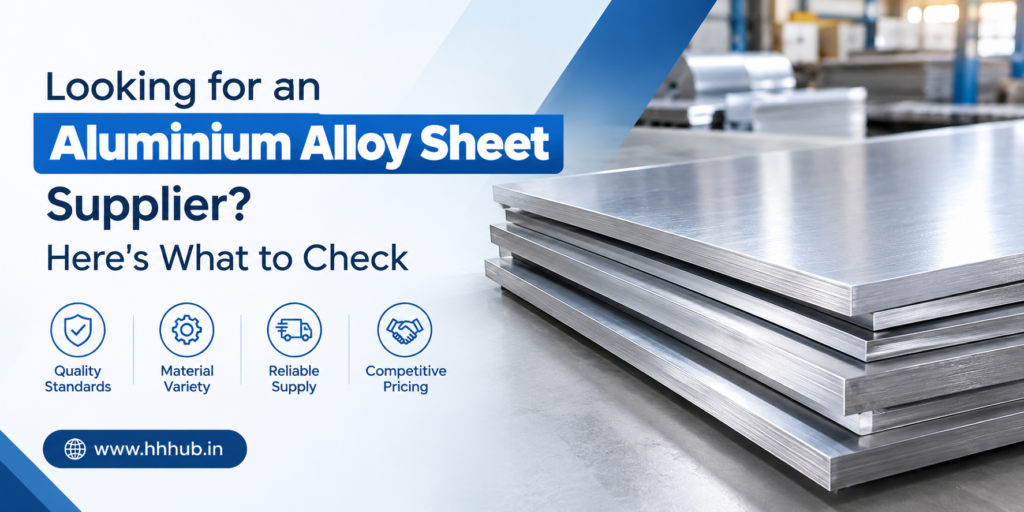
Looking for an Aluminium Alloy Sheet Supplier? Here’s What You Should Check
Finding an aluminium alloy sheet supplier is easy. Finding one who has the right alloy, temper, thickness and quantity available when you actually need it can be much harder. This becomes particularly important for manufacturers who need material for sampling, a small production run or an urgent order. Many buyers don’t need tonnes of aluminium – they may need a few sheets or a specific thickness to keep production moving. Before choosing a supplier, therefore, don’t compare only the Rs./kg price. Check material availability, alloy and temper knowledge, quality, quantity flexibility, processing capability and delivery reliability. What is an Aluminium Alloy Sheet? Aluminium alloy sheets are flat-rolled aluminium products in which aluminium is combined with elements such as magnesium, manganese, silicon or copper to achieve different mechanical and fabrication properties. Changing the alloy and temper can significantly affect strength, formability, corrosion resistance, weldability, machinability, electrical and thermal conductivity, and surface characteristics. That is why simply asking for “2 mm aluminium sheet” is often not enough. Alloy + Temper + Thickness + Sheet Size + Quantity For example: 5052 H32 – 2.0 mm – 1220 x 2440 mm – 20 sheets. This gives the supplier enough information to identify the correct material. Common Aluminium Sheet Alloys Alloy Relative Strength Formability Corrosion Resistance Common Applications 1200 Low Excellent Excellent General fabrication, electrical parts, labels, reflectors, formed components 8011 Low-Moderate* Very Good* Good Closures, packaging-related and selected industrial applications 3003 Moderate Very Good Very Good General fabrication, equipment, panels, heat-transfer applications 5052 Medium-High Good-Very Good* Excellent Enclosures, automotive parts, tanks, industrial fabrication 6061 High* Moderate* Good Engineering and structural applications *Properties depend significantly on temper 1200 – choose when excellent formability, corrosion resistance and conductivity are important and high strength isn’t required. 3003 – useful when you need more strength than commercially pure aluminium while retaining good workability. 5052 – preferred where higher strength, good forming capability and excellent corrosion resistance are required. 6061 – commonly selected for higher-strength engineering applications, subject to the required temper and specification. 8011 – used for specific forming and industrial applications; suitability should be checked against the actual end use and temper. At HHHUB, 1200, 8011 and 5052 are among our most regularly dealt aluminium alloys, along with other grades depending on customer requirements. Temper is Equally Important Two sheets of the same alloy and thickness can behave differently if their tempers are different. O Temper – annealed/soft material offering high formability. H Temper – strain-hardened material available in different hardness and strength levels. T Temper – heat-treated condition used with heat-treatable alloys such as 6061. For bending, deep drawing or forming applications, specifying the wrong temper can result in cracking or poor fabrication. If your drawing specifies a temper, don’t substitute it simply because another temper is available at a lower price. What Should You Check in an Aluminium Sheet Supplier? Standard Aluminium Sheet Sizes Common sheet dimensions in the Indian market include approximately: Other widths, lengths and thicknesses are available depending upon the alloy, brand and stock position. Send your exact requirement and ask the supplier to confirm the nearest available specification. How is Aluminium Sheet Price Calculated? Aluminium prices are market-linked and change regularly. The actual selling price can depend on: Send These Details for a Faster Quote Don’t know the alloy? Tell us what you are manufacturing, whether the sheet will be bent, formed, welded,machined or anodised, and what strength or finish you require. HHHUB can help narrow down the available options,subject to your final technical approval. Why Manufacturers Choose HHHUB for Aluminium The aluminium market traditionally works well for buyers purchasing large quantities. But what happens when amanufacturer needs only a few sheets, needs material today, or is developing a new product and doesn’t want toinvest in hundreds of kilograms before knowing whether it will succeed? This is precisely the problem HHHUB was built to solve. We maintain ready stock across multiple aluminium alloys, thicknesses and brands and serve requirements ranging from a single sheet to regular bulk industrial quantities. Ready Stock – Material available for faster fulfilment, subject to current inventory. No MOQ – Buy what your production requires – not what your supplier forces you to buy. Multiple Alloys & Brands – A wider sourcing base makes it easier to find material suited to the actual application. Retail to Bulk – Sampling, development quantities, small production batches and regular industrial requirements. Cut-to-Size Support – Reduce unnecessary material purchase and processing wherever practical. Technical Guidance – Tell us your application and we can help you understand the relevant aluminium options. The Bottom Line Choosing an aluminium alloy sheet supplier shouldn’t come down to who quotes the lowest rate today.Does the supplier have my material?Can I buy the quantity I actually need?Do they understand the alloy and temper? Can they process it if required?Can they deliver when my production needs it?Because when production is waiting, availability is often more important than a small difference in price.At HHHUB, our objective is simple: No manufacturer should have to stop, delay an order or buy unnecessary quantities becausethe right aluminium isn’t available.Need Aluminium? Think HHHUB.Ready Stock | No MOQ | Multiple Alloys & Brands | Retail to Bulk | Cutting Support Frequently Asked Questions Can I buy a single aluminium sheet from HHHUB? Yes. HHHUB has no MOQ, subject to material availability. You can purchase a single sheet, sampling quantity or bulk requirement. Which aluminium sheet alloy should I choose? It depends on the required strength, formability, corrosion resistance, fabrication process and end application. Share your application with HHHUB if you’re unsure. What is the difference between 1200 and 5052? 1200 is a commercially pure aluminium grade offering excellent formability and corrosion resistance but relatively low strength. 5052 is an aluminium-magnesium alloy offering substantially higher strength together with excellent corrosion resistance. Do you stock Hindalco aluminium sheets? Yes. HHHUB deals in Hindalco aluminium sheets, including commonly required grades and specifications, subject to current stock availability. Can aluminium sheets be supplied in custom sizes?Yes. Cutting
Looking for an Aluminium Alloy Sheet Supplier? Here’s What You Should Check Read More »