
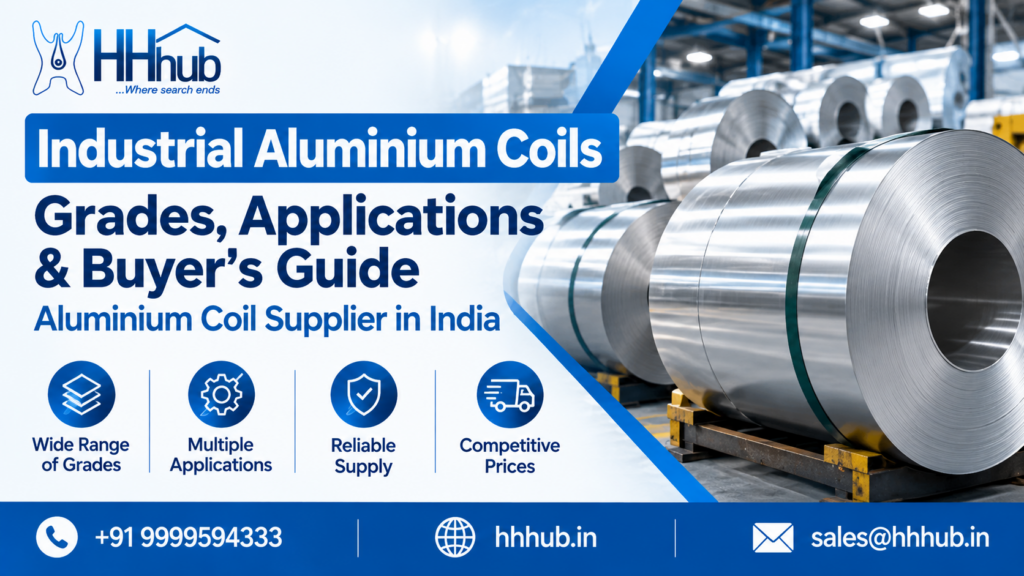
Why Choosing the Right Aluminium Coil Matters
Industrial buyers rarely purchase aluminium coils simply because the metal is lightweight. They buy a defined material that must pass through cutting, forming, stamping, insulation, cladding or other production processes without causing preventable problems. A coil with the wrong temper, width tolerance or finish can create more waste than its lower purchase price saves.
Industrial Aluminium Coils are used in manufacturing, construction, electrical components, HVAC equipment, transportation and general fabrication. Their popularity comes from aluminium’s useful combination of low density, corrosion resistance, formability and thermal conductivity. But these properties vary across alloys and tempers; not all coils are suitable for every application.
This guide explains how industrial aluminium coils are made and supplied, the grades and finishes buyers commonly consider and how to prepare a precise enquiry for a supplier in India.
Quick Answer: What Are Industrial Aluminium Coils?
Industrial Aluminium Coils are flat-rolled aluminium products supplied as continuous lengths wound into coils rather than as individual sheets. They are specified by alloy, temper, thickness, width, surface condition and coil dimensions. Manufacturers and fabricators use them for repeated cutting, slitting, stamping, bending and forming operations. The right grade depends on the required strength, corrosion resistance, formability, appearance and performance of the finished component.
How Are Industrial Aluminium Coils Produced?
Aluminium is converted into a flat-rolled product through processes that control thickness, surface quality and mechanical properties. The precise production route depends on the mill, alloy and final product.
A simplified coil-production and supply workflow includes:
- Alloy preparation. The aluminium chemistry is controlled to meet the designated alloy specification.
- Rolling. The material is reduced to the required gauge through appropriate hot or cold rolling operations.
- Temper control. Rolling and, where relevant, thermal processing establish the required mechanical condition.
- Surface processing. The coil may remain mill-finished or receive coating, cleaning or other finishing steps.
- Slitting or cut-to-width preparation. Master coils can be processed into narrower widths for a specific production line.
- Inspection. The supplier or mill checks applicable dimensions, surface requirements and material documentation.
- Packing and dispatch. Coils are restrained and protected for transport and later handling.
The buyer’s part begins before dispatch. Sending a complete specification helps the supplier identify a compatible grade and avoid substitutions that could disrupt production.
Main Characteristics of Industrial Aluminium Coils
| Property | Practical advantage | What buyers should remember |
|---|---|---|
| Low density | Useful where component weight matters | Strength requirements still determine alloy and thickness |
| Corrosion resistance | Helpful for many building and industrial uses | Performance varies with environment, alloy and surface treatment |
| Formability | Supports bending, rolling and stamped components | Depends strongly on temper and bend geometry |
| Thermal conductivity | Useful in heat-transfer equipment | Varies with composition, thickness and design |
| Surface versatility | Mill, coated and decorative finishes available | Specify appearance and coating requirements clearly |
| Continuous coil supply | Supports repetitive automated production | Coil size must be compatible with handling machinery |
Aluminium is not interchangeable with steel or copper in every application. A material decision should consider load, conductivity, cost, joining processes and the conditions the finished product will face.
Common Aluminium Alloys Used for Industrial Coils
Different alloy families offer different balances of mechanical properties and workability. The following examples describe general industry uses; suppliers must confirm the exact alloy and form available for a given enquiry.
| Aluminium grade | General characteristics | Example applications |
|---|---|---|
| 1200 | Commercially pure aluminium with good workability and corrosion resistance | General forming, selected electrical and heat-transfer components |
| 3003 | Aluminium-manganese alloy with good formability and moderate strength | Panels, cladding, general fabrication and heat-exchanger parts |
| 3105 | Aluminium-manganese-magnesium alloy used in formed building products | Coated panels, roofing and gutters where specifications permit |
| 5052 | Aluminium-magnesium alloy with relatively good strength and corrosion resistance | Enclosures, fabricated components and industrial panels |
| 8011 | Aluminium alloy used in certain sheet, foil and industrial applications | Packaging-related and selected formed products, subject to temper |
A purchase order should identify alloy and temper together. For example, 3003-O and 3003-H14 are not equivalent simply because both carry the 3003 designation. Temper describes the mechanical condition, which affects hardness, ductility and bending performance.
Main Types of Industrial Aluminium Coils
Mill-Finish Aluminium Coils
A mill-finish coil retains the surface produced by rolling, subject to the applicable quality grade. It is commonly selected where the final product will be processed further or its surface will not remain exposed as a decorative finish.
Colour-Coated Aluminium Coils
Pre-painted coils are used where a defined appearance and protective coating are needed. Buyers should specify coating type, colour reference, thickness, expected environment and whether bending or profiling will take place after supply.
Slitted Aluminium Coils
A master coil can be cut into narrower strips to suit stamping, forming and feed equipment. Slit width, edge quality, camber, burr limits and winding conditions become important when narrow material must travel through a fast production line.
Aluminium Coil Rolls from Recognised Brands
Supplier catalogues may organise coils by rolling-mill brand as well as alloy. Brand can be helpful for sourcing consistency, but buyers should still verify the exact material designation, certificate and available sizes for each consignment.
Key Specifications to Check Before Buying Aluminium Coils
The fastest way to receive a useful quote is to share a complete specification. At minimum, a buyer should consider the following:
| Specification | Example of what to provide | Why it matters |
|---|---|---|
| Alloy and temper | 3003-H14 or 5052-H32, as required | Sets mechanical and forming characteristics |
| Thickness | Nominal gauge plus tolerance | Affects weight, strength and tool setup |
| Width | Full coil or defined slit width | Must fit the production line |
| Coil inner diameter | Required core/mandrel size | Determines uncoiler compatibility |
| Outer diameter and weight | Maximum allowed by handling equipment | Affects safe lifting and storage |
| Surface finish | Mill finish, coated or specified treatment | Determines appearance and downstream processing |
| Edge and shape quality | Burr, camber and flatness requirements | Influences feeding and final-part quality |
| Documentation | Material test certificate or specified standard | Supports inspection and traceability |
Why Thickness Tolerance Matters
A coil that varies excessively in gauge can create trouble in forming dies, sheet-metal assemblies or tightly controlled insulation products. State the required standard and tolerance rather than assuming that any coil labelled ‘1 mm’ will behave identically.
Why Coil Geometry Matters
Coils are often handled with cranes, forklifts or specialised lifting devices and then mounted onto decoilers. Inner diameter, maximum outside diameter and weight are therefore machine-compatibility and safety requirements, not minor shipping details.
Why Surface and Edge Quality Matter
Scratches, dents, oil contamination, edge burrs or unsuitable coating can affect final-part quality. For visible architectural uses, the appearance specification may be as important as strength. For slitted coils, correct winding tension and protected edges help prevent handling damage.
Benefits of Using Industrial Aluminium Coils
Efficient Continuous Processing
Coil supply suits repeated, high-volume operations such as profiling, stamping or converting, reducing the need to feed many individual sheets. The benefit depends on the equipment and the production run length.
Flexible Fabrication Options
The broad range of alloys, thicknesses, widths and finishes gives engineers options for different forming and manufacturing processes. The application must still be matched to a suitable material specification.
Weight Reduction
Aluminium’s relatively low density can help reduce component weight. In equipment, vehicle and building applications, the complete design must be checked for strength, stiffness, fatigue and joining requirements.
Material Planning for Repeat Orders
Standardising alloy, temper and coil dimensions can support purchasing consistency, help control scrap and simplify quality checks across production batches.
Industrial Applications of Aluminium Coils
Construction and Architectural Products
Aluminium coils can be converted into cladding, roofing, rainwater products, trim and coated panels. Buyers should consider outdoor exposure, coating performance, surface appearance and the forming process.
HVAC and Heat-Transfer Equipment
Selected aluminium alloys are used in heat exchangers, duct-related components, insulation jacketing and other thermal applications. Thermal performance alone does not determine suitability; corrosion and forming needs also matter.
Automotive and Transportation Components
Aluminium coil stock can be formed into selected brackets, enclosures, panels and other parts. Materials must meet the intended mechanical and manufacturing requirements rather than being chosen only for their low mass.
Electrical and Electronic Enclosures
Aluminium’s workability and conductivity make it useful for a variety of housings and components. Electrical performance and safe product design must be assessed against the specific application.
General Engineering and Fabrication
Metalworking businesses use coil feedstock for repeated cut blanks, formed parts and fabricated assemblies. Tight control of dimensions and surface condition is important for stable downstream production.
How to Choose an Industrial Aluminium Coil Supplier in India
A reliable supplier should be able to translate a buyer’s drawing or material specification into a precise commercial offer. Before ordering:
- Share the alloy, temper, thickness, width, finish and expected use.
- Specify any applicable standard and dimensional tolerance.
- Confirm mill origin or brand requirements if relevant to the purchase.
- Check coil inner diameter, maximum size and lifting arrangements.
- Ask whether material is full-width, slit or otherwise processed.
- Clarify test certificates and lot traceability requirements.
- Confirm order quantity, lead time, packing and damage-claim process.
- Agree how non-conforming material will be inspected and handled.
A sample or trial batch may be worthwhile when introducing a new grade, supplier or forming operation. Inspect real production performance before committing to a larger volume, particularly where appearance and forming behaviour are critical.
Why Consider HHhub for Industrial Aluminium Coils?
HHhub lists aluminium coils among its industrial metal products and describes a portfolio that includes Hindalco, Virgo and Paragon aluminium coil offerings, as well as slitted and colour-coated coil categories. Its website positions the business as an aluminium supplier serving industrial and fabrication applications in India.
Explore HHhub’s Industrial Aluminium Coils category to review the listed product options. For a quotation, provide the exact alloy-temper combination, width, gauge, finish, quantity and delivery requirements. Confirm availability and supporting documentation for the specific item you intend to purchase.
Common Aluminium Coil Buying Mistakes to Avoid
| Mistake | Why it leads to problems | Better approach |
|---|---|---|
| Ordering by thickness alone | Alloy and temper strongly affect performance | Specify complete material designation |
| Ignoring coil ID and weight | Material may not fit or be safe for the decoiler | Share machine handling limits |
| Treating all finishes as equal | Appearance or coating may fail expectations | State the required surface and coating standard |
| Omitting width and edge tolerances | Can create feed or cutting defects | Agree dimensional limits before supply |
| Assuming a named alloy is always in stock | Availability varies by grade and size | Obtain written stock and lead-time confirmation |
| Skipping certificates and inspection | Makes disputes and traceability harder | Define documents and acceptance tests |
Frequently Asked Questions
What are industrial aluminium coils used for?
They are used as continuous flat-rolled feedstock for manufacturing, construction products, HVAC components, enclosures, transport parts and general fabrication. The suitable grade depends on the end use.
Which aluminium grade is best for industrial coils?
There is no single best grade. For example, 3003 is often chosen for formable general fabrication, while 5052 is used where greater strength and corrosion resistance are required. Temper and product design must also be considered.
What is the difference between aluminium sheets and aluminium coils?
Sheets are supplied as cut lengths, while coils are wound continuous material that can be unwound and processed. Coil supply often suits repetitive production, while sheets may be preferable for smaller jobs or certain fabrication workflows.
Are slitted aluminium coils available for custom widths?
Suppliers can offer slit coils for some products and order requirements. The achievable width and edge quality depend on the material, gauge, available slitting equipment and agreed tolerances.
What should I send when requesting an aluminium coil price?
Share alloy and temper, thickness, width, coil ID, quantity, finish, location, delivery timeline and any required certification. This helps the supplier prepare an accurate quotation and identify alternatives if a specification is unavailable.
Conclusion: Buy Aluminium Coils by Specification, Not Description
Industrial Aluminium Coils can support efficient, repeatable manufacturing when the material matches the product and equipment. Alloy, temper, gauge, surface quality, coil geometry and delivery condition all influence the final result, so a complete buying specification is essential.
To compare available product categories and request a quote, visit HHhub’s Industrial Aluminium Coils page with your technical requirements ready.